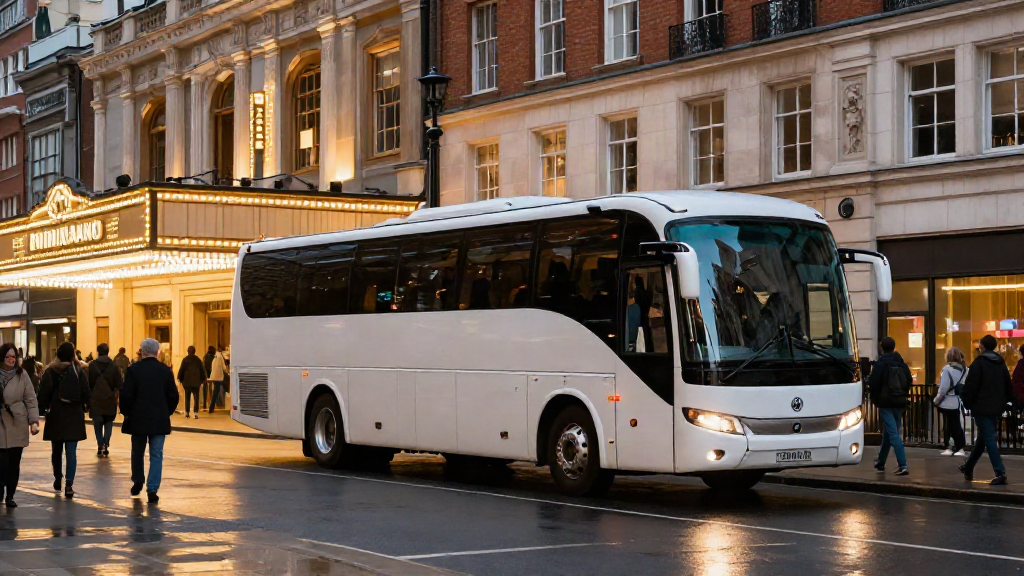
Getting a full coach party to a West End theatre on time is a different job from driving a car into central London. The streets around Theatreland are narrow, heavily restricted, and busy long before curtain-up. The good news is that the drop-off points work well once you know which one serves your theatre, and a realistic timing plan takes almost all of the stress out of the evening.
If you are leading a school group, a performing-arts tour, a cruise extension, or a tour group from the US, Canada, or overseas, this guide covers the practical side: where coaches can set down and collect, how London traffic and coach regulations affect your arrival time, and a simple checklist you can hand to your group so everyone is seated with time to spare.
Why West End drop-offs need planning
Most London theatres sit inside the City of Westminster and Camden, two boroughs that tightly control where large vehicles can stop. Coach bays are limited, some streets are closed to coaches during the evening peak, and a coach that blocks a bus lane or a loading bay can be moved on quickly, with the driver facing a penalty. That is why a coach cannot simply pull up outside the stage door five minutes before the show.
The other half of the challenge is that the coach has to go somewhere while your group is inside. West End performances run roughly two and a half to three hours with an interval, and very few theatres have anywhere nearby for a large vehicle to wait. In practice, the coach drops your group, leaves to a legal waiting location or returns later, and comes back to a pre-arranged pickup point after the show.
The main West End coach drop-off and pickup points
These are the areas that work most reliably for theatre transfers. The right one depends on your theatre, your group size, and the time of day, and your operator will confirm the exact bay once your itinerary is set.
Victoria and Victoria Coach Station
Victoria is the workhorse of West End group transport. Victoria Coach Station on Buckingham Palace Road is a purpose-built terminal with space for large vehicles, and it is a short transfer from the Victoria theatres, including the Victoria Palace and the Apollo Victoria. It is also the most sensible set-down for groups arriving straight from Gatwick, Heathrow, or a cruise terminal at Southampton, because the coach can unload properly instead of circling Theatreland.
Aldwych and the Strand
Aldwych is the classic West End set-down. It sits between the Strand and the Royal Courts of Justice, a short walk from Theatre Royal Drury Lane, the Lyceum, the Duchess, and the Novello, and within easy reach of Covent Garden. The wide carriageway gives a coach room to pull in and unload without holding up traffic, which matters when you are moving thirty or forty people with bags and instruments.
Waterloo and the South Bank
For the Old Vic, the National Theatre, and the Young Vic, the South Bank and Waterloo area is the natural choice. It also works as an overflow option on very busy nights, with a short walk across Waterloo Bridge into Covent Garden and the Aldwych theatres. Groups heading to the Royal Festival Hall or the Southbank Centre should treat Waterloo as their default drop-off.
Kingsway, Holborn, and Russell Square
Kingsway and the Holborn corridor serve the theatres along the eastern edge of Theatreland, including the Fortune and the Peacock, and give coaches a straighter, less congested approach than Shaftesbury Avenue. Further north, Russell Square and Southampton Row are useful for the Dominion Theatre on Tottenham Court Road and for groups staying in the Bloomsbury hotel district.
Park Lane and Hyde Park Corner
When you need somewhere for a large coach to wait legally, or your group is coming in from the west, Park Lane and Hyde Park Corner are the standard holding areas. They are not theatre doorsteps, but they are a short, straightforward run to Victoria, Mayfair, and the Piccadilly theatres, and they keep your driver legal and rested rather than circling the block.
How London traffic, congestion rules, and coach restrictions affect your arrival
Three practical factors decide whether your group walks in calm or runs in late.
The evening peak does not end when the show begins. Central London traffic is at its worst between roughly 4:30 pm and 7 pm, exactly when most groups are heading to a 7:30 pm curtain. A journey that takes twenty minutes at midday can take forty-five in the peak, so build the buffer into your schedule rather than hoping for a clear run.
Restrictions are enforced, and they are local. The Congestion Charge applies to vehicles driving in the central zone during charging hours, and the Ultra Low Emission Zone covers most of Greater London. Both are normal operating costs for a professional coach company, but they are part of why a licensed London operator quotes differently from a company coming in from outside the city. Westminster also enforces coach bay time limits and banned turns that change from street to street, so the driver needs to know your exact theatre in advance, not on the night.
Coach size changes the plan. A 53-seat coach and a 16-seat minibus do not use the same streets. If your group is large, or you are traveling with sets, instruments, or mobility equipment, tell your operator early. The right vehicle often solves a drop-off problem before it starts.
A simple timing checklist for curtain-up
- Confirm the theatre and the exact bay at least a week before you travel, and share the theatre name with your driver, not just the postcode.
- Set your arrival for 60 to 75 minutes before curtain if you are coming from outside central London. That covers traffic, the set-down, and the walk.
- Plan a walking time of 5 to 12 minutes from the drop-off bay to the auditorium doors. Groups move slowly with coats, bags, and a headcount.
- Aim to be inside the foyer 30 minutes before the show. Doors typically open 30 to 45 minutes ahead, and a group of twenty takes far longer to seat than a couple.
- Fix your pickup point and time before the show starts. The coach will not be waiting outside the door, so agree on a landmark and a fifteen-minute collection window.
- Give every group leader the driver’s number and the pickup address in writing. One point of contact on each side prevents the 10:30 pm phone-tree problem.
What to confirm with your coach company
Before you book, ask four questions. Where exactly will we be set down, and how far is the walk? Where will the coach wait during the performance? What is the pickup arrangement if the show runs late? And who do we call on the night if plans change?
A good London operator answers all four without hesitation, because they do this every week. You should also expect clear, upfront pricing that includes the Congestion Charge, the ULEZ, driver hours, and waiting time, so there is no surprise on the invoice after your trip.
Booking your West End theatre transfer
Coach Bus Hire has spent more than 30 years moving groups through London, including theatre and performing-arts tours, school and university trips, cruise passengers, and tour operators from the US, Canada, and overseas. We know which bays work for which theatres, we plan the timing around real London traffic, and we give you one named contact who answers the phone before you commit, plus a direct US and Canada number so you are not juggling time zones.
Tell us your theatre, your date, and your group size, and we will come back with a clear, no-obligation quote and a timing plan built around your curtain-up. We handle the coach so you can focus on the trip.